People usually arrive asking about veneers as though it were one treatment. It is really one word covering two quite different approaches, and choosing between them is most of the decision.
Both put a thin covering over the front of a tooth to change its shape, color or apparent alignment. What separates them is where that covering is made, how much of your tooth it costs you, how long it lasts, and how quickly you walk out with it.
Composite veneers: built on the tooth, in one visit
Composite is a tooth-colored resin shaped directly onto your tooth by hand, layer by layer, and hardened with a curing light. Dr. Cheung sculpts and polishes it in the chair while you are there.
The appeal is how little it asks of you. When the underlying tooth is intact, this can often be done without drilling and without anesthetic, which surprises most people. You come in with one smile and leave the same day with another. If a corner chips years later, it can usually be repaired by adding more material rather than replacing the whole thing.
The trade-offs are real and worth knowing. Composite picks up stain over time in a way natural enamel does not, so coffee, tea, red wine and tobacco show up on it sooner. It is also softer than porcelain and more prone to chipping at the edges. On our own service pages we put the working expectation at roughly five to seven years before composite veneers need refreshing or replacing.
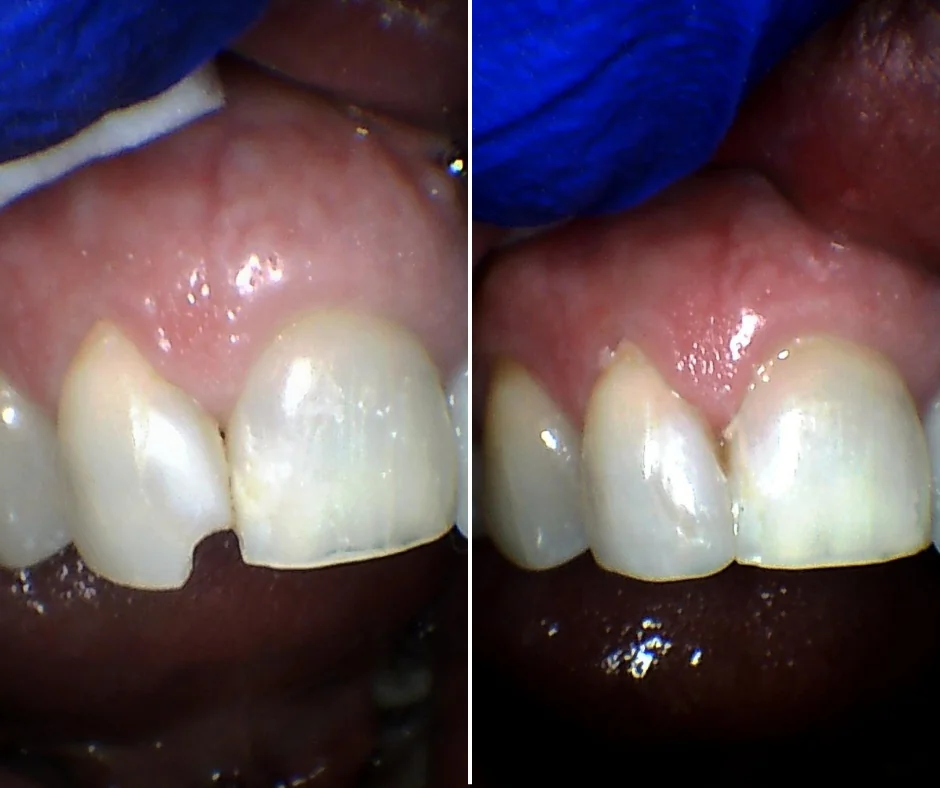
You can see real chairside composite work in our smile gallery, including a case where two front teeth were reshaped and color-matched in a single visit, and more on the approach on our cosmetic dentistry for front teeth page.
Porcelain veneers: made in a lab, placed over two visits
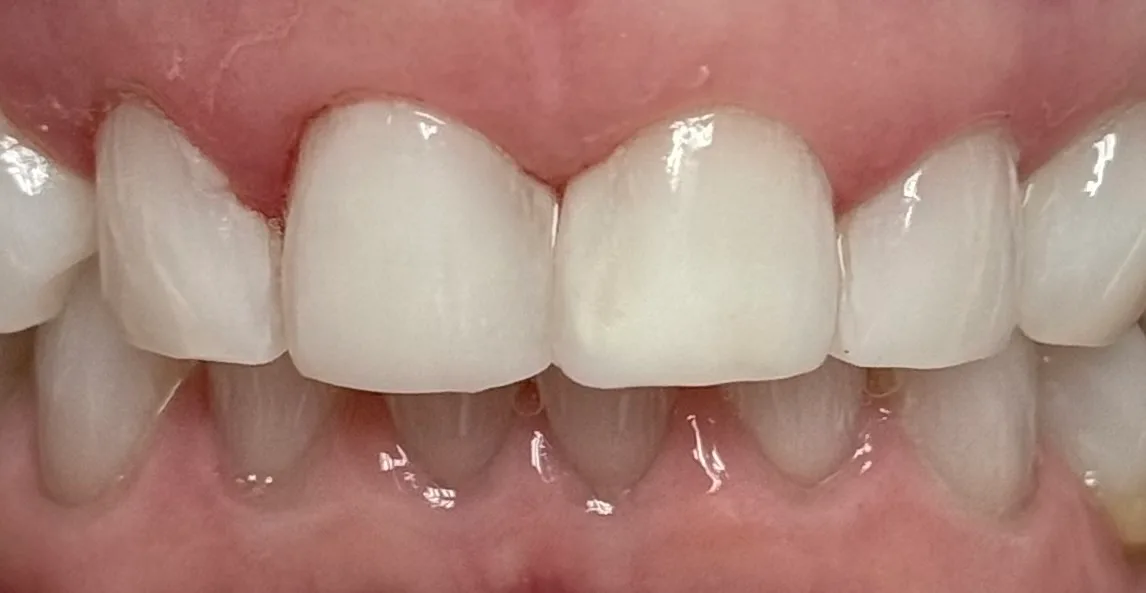
Porcelain veneers are custom-made outside the mouth and then bonded on. The first visit involves removing a thin layer of enamel so the veneer sits flush rather than bulky, taking digital impressions, and fitting temporaries. The finished veneers are bonded and adjusted at a second visit.
Porcelain earns its cost in two ways. It resists staining far better than composite, holding its color through years of coffee. And it lasts longer, commonly ten to fifteen years and often more with good care.
The significant trade-off is that it is not reversible. Enamel does not grow back, so a tooth prepared for a porcelain veneer will need a veneer or a crown on it from then on. That is not a reason to avoid porcelain. It is a reason to be sure before starting.
The questions that actually decide it
Rather than comparing the materials in the abstract, these are the questions that tend to settle it:
- How soon do you need it? Composite finishes the same day. Porcelain takes two visits with lab time between.
- What is the budget? Composite costs less per tooth up front, though it is replaced more often, so the picture over a decade is closer than it first looks. Our veneer cost breakdown works through it.
- How many teeth? For one or two teeth, composite is frequently the sensible answer. Across six or eight front teeth where uniform color matters, porcelain usually holds up better.
- Do you want to keep the option to undo it? If reversibility matters to you, that points to composite.
- Do you stain things? Heavy coffee, tea or tobacco use is an argument for porcelain.
- Do you grind or clench? Grinding shortens the life of either option. If you wake with a sore jaw or worn edges, read our post on night guards and splint therapy first, because protecting the result matters as much as choosing it.
What veneers will not do
Two honest limits, because they catch people out.
Veneers are cosmetic. They do not treat decay or gum disease, and neither material bonds reliably to an unhealthy foundation. Any active problem gets handled first, which is not a delaying tactic but the thing that makes the result last.
And veneers do not respond to whitening. Once they are on, their shade is fixed while your surrounding natural teeth carry on aging. If whitening is part of your plan, it happens first, and the veneers are then matched to the brighter shade.
Veneers also do not move teeth. They can make mild crookedness read as straighter, but a genuine bite problem is an alignment question, and Invisalign or braces is the honest answer to it.
Where bonding fits in
Composite veneers and dental bonding use the same material. The difference is scope. Bonding usually addresses one specific thing, a chipped corner or a single gap, while a composite veneer reshapes the whole visible face of the tooth. If your concern is one chip rather than the overall look of the tooth, start with our guide to what dental bonding can fix, which is very likely the smaller and cheaper answer.
Working out which one is yours
The choice depends on your teeth, your habits, your timeline and your budget, and it is genuinely hard to settle from an article. What helps is sitting down with someone who will tell you when the cheaper option is the better one.
Our page on whether veneers are right for you is a good place to think it through, and veneer lifespan and maintenance covers what looking after either material involves.
If you are in Lodi, Galt, Stockton or the wider San Joaquin County area, book a cosmetic consultation through our contact page or call (209) 369-3617. We are open Monday through Thursday, 8 AM to 5 PM. Bring photos of smiles you like. It tells us more than adjectives do.
Frequently Asked Questions
- What is the difference between composite and porcelain veneers?
- Composite veneers are sculpted directly onto the tooth in a single visit and can often be done without drilling. Porcelain veneers are made in a lab and bonded over two visits, which requires removing a thin layer of enamel. Porcelain resists staining better and lasts longer; composite is faster, less expensive up front, and reversible.
- How long do composite and porcelain veneers last?
- As a working expectation, composite veneers last around five to seven years before needing refreshing or replacement, while porcelain veneers commonly last ten to fifteen years or longer. Grinding, staining habits and home care all shift those figures in either direction.
- Do veneers ruin your natural teeth?
- Composite veneers can often be placed without removing enamel, so the tooth underneath is largely unchanged. Porcelain veneers require removing a thin layer of enamel, which does not grow back, meaning the tooth will need a veneer or crown from then on. That is the main reason to be certain before choosing porcelain.
- Can veneers be whitened later?
- No. Veneers keep the shade they were made in and do not respond to whitening treatments. If you want a brighter smile overall, whiten your natural teeth first and have the veneers matched to that shade afterwards.
- Are veneers covered by dental insurance?
- Veneers are usually classed as cosmetic and are rarely covered. There are occasional exceptions where a restoration is needed for structural rather than purely aesthetic reasons. We submit a pre-treatment estimate whenever coverage is plausible, and we work with CareCredit and Sunbit for the rest.