
Dental Coverage Is a Budget, Not a Safety Net
Your medical plan exists so that a serious illness does not bankrupt you. The worse things get, the more it pays. Dental coverage works the other way around. It pays generously for small things, and then it stops.
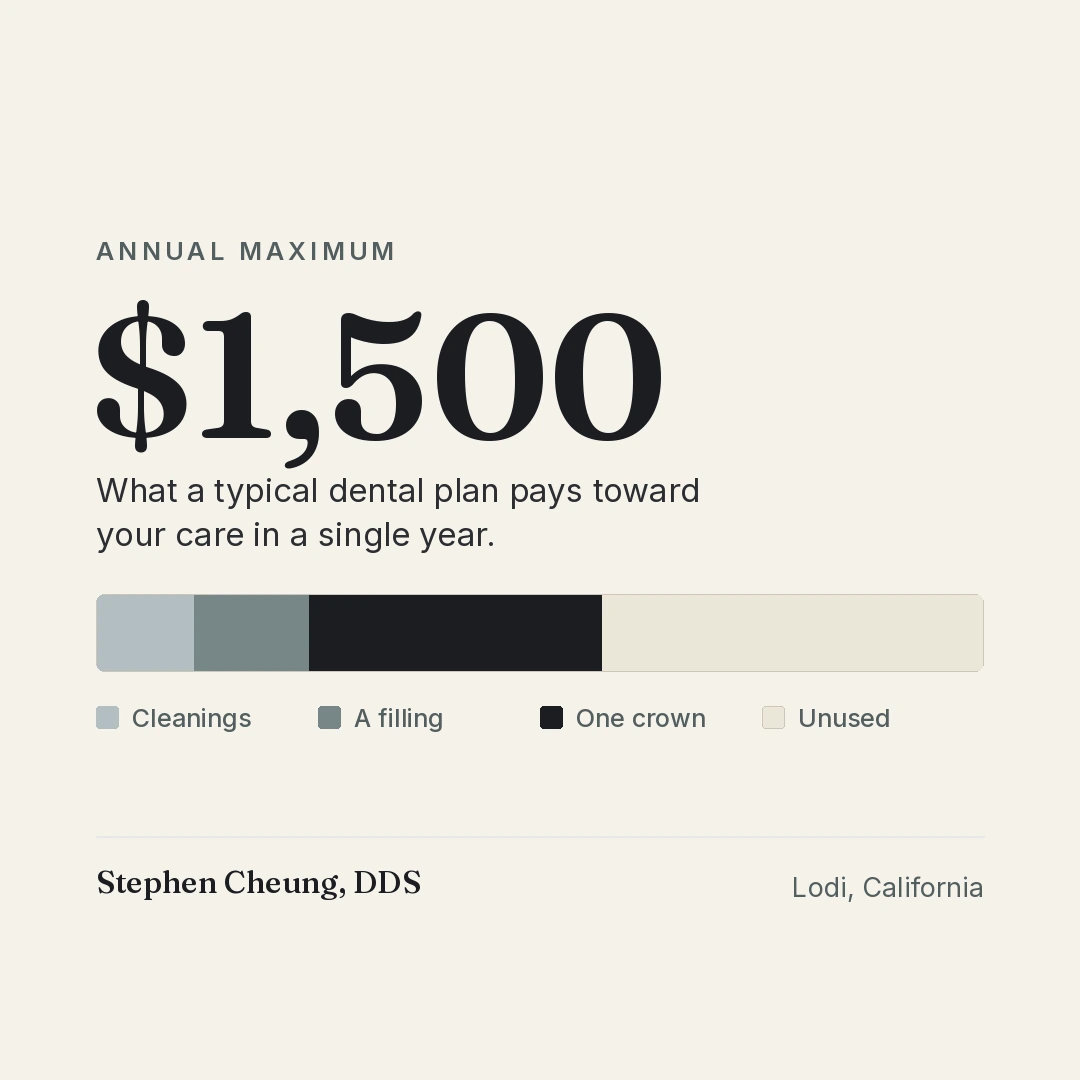
The reason is the annual maximum. Almost every dental plan sets a ceiling on what it will pay out in a plan year, and most ceilings land between $1,500 and $2,000. Cleanings and exams barely touch it. One crown can use a third of it. A root canal, a buildup and a crown on the same tooth can finish it by March.
Once you reach that ceiling, the plan pays nothing further until the year resets, no matter what happens to your teeth in the meantime.
About 12% of insured adults run out of benefits every year
That is roughly 32 million people, according to the CareQuest Institute for Oral Health. Among those who hit the ceiling, 59% of adults in households earning under $30,000 said it stopped them from getting further treatment, compared with 35% of those earning over $100,000. The cap does the most damage to the people with the least room to absorb it.
So the useful way to think about your dental plan is not as insurance against a bad outcome. It is a fixed annual allowance toward dental care, and nearly all of the planning value comes from knowing how much of it is left.
Why the Rules Differ From Your Medical Plan
| How they compare | Medical plan | Dental plan |
|---|---|---|
| What it is built for | Protecting you from a catastrophic bill | Offsetting routine and moderate costs |
| As treatment gets more expensive | Pays a larger share, then everything past your out of pocket maximum | Pays a smaller share, then nothing past the annual maximum |
| Yearly cap on what it pays out | No dollar cap on essential health benefits | Commonly $1,500 to $2,000 |
| Who regulates it | California, for most plans | California for some plans, federal law for close to half |
That last row is the one almost nobody knows about, and it is where most of the frustration comes from.
When your coverage comes through a large employer that funds its own benefits, the plan answers to federal law rather than to California. State regulators cannot review it, cannot enforce California standards against it, and often cannot help you when a claim goes wrong. According to the California Dental Association, more than 40% of Californians with dental coverage are in these federally regulated plans, and close to half of everyone with commercial dental coverage holds a plan sitting outside state level protections.
Two patients can sit in the same chair, hold cards from the same carrier, and have different rights depending on who their employer is and how the plan is funded.
What California Has Already Fixed
Here the news is better than most patients realize. A series of state laws has closed some of the worst gaps, and these are already in force.
- January 2025Preexisting conditions and waiting periods endA plan can no longer deny a dental claim because the condition existed before you enrolled. Large group plans can no longer impose a waiting period before full benefits begin, and California gained the power to review dental premium increases.
- January 2025State regulated plans have to identify themselvesA plan that California regulates must carry the words "State Regulated" on your identification card, and must make that status available to your dentist's office on request.
- April 2026Fees stop coming out of paymentsPlans can no longer default to paying a dental office by virtual credit card. Between the card fee and the merchant fee, that method could take as much as 10% off a payment before it reached the office. That money now goes to patient care.
- January 2027Direct payment, and estimates that holdPlans must honor your request to pay your dentist directly, and cannot reimburse less than the amount they put in writing in a predetermination.
None of this appears as a headline on your benefits statement, but each one removed a specific way coverage used to fall apart. One caution on the identification card rule: the law only requires the flag when a plan is state regulated. If those words are missing, treat it as a signal rather than proof, because federally regulated plans are not required to announce themselves.
What Changes on January 1, 2027
On September 27, 2026, Governor Newsom signed Assembly Bill 1629, authored by Assemblymember Matt Haney. It cleared its final Assembly vote 62 to 5 with support from members of both parties, and passed the Senate 30 to 10. Three parts of it change how paying for dental care actually feels.
Your plan has to honor an assignment of benefits. If you ask your plan to pay your dentist directly, it has to. Until now some plans would send the check to the patient instead when the dentist was out of network, which meant paying the full bill up front and waiting on a reimbursement. On a $1,400 crown, that difference is not academic.
Your plan has to stand behind its own estimate. When a dentist submits a treatment plan in advance and your plan responds with a predetermination, it can no longer pay less than that figure later. The exceptions are narrow: fraud, a billing error, or a loss of coverage in between. A predetermination used to be closer to an educated guess than a commitment, which is why pre treatment estimates sometimes did not survive contact with the actual claim.
Regulators finally get to see the networks. Plans must report provider network information across all their plans, so the state can identify networks too thin to deliver care. A directory full of dentists who are not accepting new patients is not a network, and now there will be data to prove it.
There is a fourth piece, and it applies to us rather than to your insurance company. Before our office accepts an assignment of benefits on out of network coverage, we will be required to tell you in writing that we are out of network, that you may pay less with a dentist inside your plan's network, and what we estimate the treatment and your share of it will cost. We already aim to do all three. From January it is the law, and we have no complaints about that.
How to Get More Out of the Plan You Have
Legislation helps over years. These habits help this month.
- Know your annual maximum and the date it resets. On most plans unused benefits do not roll over, and for most people the year ends December 31, though some employer plans run on a different schedule. Our guide to annual maximums, deductibles and the calendar reset walks through the timing and the frequency limits that come with it.
- Get the estimate in writing before anything major. From January 2027 that estimate carries real weight, because your plan will not be allowed to pay less than the amount it predetermined.
- Compare the annual maximum and the waiting periods first if you are choosing coverage during open enrollment. Those two numbers will affect you more than a small difference in monthly premium. Note that the waiting period ban covers large group plans, so individual and small group shoppers still need to check.
Four questions worth asking your plan
Call the member services number on your card and ask these in order. It takes about ten minutes and it is the fastest way to find out where you actually stand.
- How much of my annual maximum is left, and what date does it reset?
- Does my plan have a waiting period on anything, and when does it end?
- Is my coverage state regulated or federally regulated?
- What percentage does the plan pay for cleanings, fillings and crowns?
Or skip the call. Give our front desk your plan details and we will verify your benefits for you before your visit.
If You Do Not Have Dental Insurance
A good number of our patients do not, because they are self employed, retired, or they ran the numbers and a plan did not pencil out. That is a reasonable conclusion rather than a problem to fix.
Our membership plan is built for exactly that situation. It is $599 a year and covers two cleanings, your annual X-rays, and 15% off everything else we do, with no deductibles and no waiting periods. There is no annual maximum to run out of, because there is no insurance company in the middle. For larger treatment, financing through CareCredit and Sunbit spreads the cost without a lump sum up front.
Where to Read More
The California Dental Association runs a campaign at fixourdentalinsurance.com that lays out the gaps in dental coverage and tracks the legislation aimed at closing them. It is the clearest summary of why dental benefits work the way they do, and it is worth ten minutes if this topic has ever frustrated you. It is an advocacy site, paid for by the CDA, and we would rather say so than not. We are pointing you to it because the information is accurate and because patients deserve to understand the system they pay into.
If you want the practical version instead, our guide to making the most of your dental benefits covers coverage tiers, deductibles and claim filing in plain terms.
Bring Us the Benefits Questions
You should not have to become an insurance expert to get your teeth looked after. That part is our job, and we would rather spend five minutes on the phone with your carrier than have you postpone treatment because the cost was unclear.
Dr. Stephen Cheung and our team see patients from Lodi, Woodbridge, Acampo, Lockeford, Galt, Linden and Stockton. We accept Delta Dental, MetLife, Cigna, Guardian and Aetna, along with most other PPO plans. Call us at (209) 369-3617 and we will check your coverage before you come in.
Frequently Asked Questions
- Does my unused annual maximum carry over to next year?
- Usually not. Most dental plans reset the maximum at the start of the plan year, which is January 1 for the majority of plans but not all of them, and anything unused is gone. Some carriers do sell a carryover or rollover feature, so it is worth asking, but do not count on having one.
- My plan denied a crown and called it a preexisting condition. Can they do that?
- If California regulates your plan, no. State law has prohibited denying dental claims on the basis of a preexisting condition since January 2025. If the plan is federally regulated through a self funded employer, the state protection may not reach it. Bring us the denial letter and we will help you work out which situation you are in and how to appeal.
- How do I tell whether my plan is state or federally regulated?
- Start with your identification card. Since January 2025, a plan that California regulates has to carry the words State Regulated on the card. If you do not see them, that points toward a federally regulated plan but does not prove it, because federal plans are not required to announce themselves. The reliable answer comes from calling the member services number on your card. Bring the card to your next visit and we will work through it with you.
- Will the new law lower what I pay out of pocket?
- Not directly. Assembly Bill 1629 does not raise annual maximums and does not change what percentage your plan covers. What it changes is cash flow and certainty. You are less likely to have to pay a full bill up front and wait on reimbursement, and a written estimate from your plan will have to be honored rather than revised downward at claim time.
- What if my plan is not one of the ones you list?
- Bring it in anyway. We see patients with out of network coverage regularly and we will still file the claim for you. From January 1, 2027, if you assign your benefits to us, your plan has to send the payment to our office rather than to you, which makes out of network care considerably easier to pay for.